jesse@chumo:~

Jesse
Chumo

Software engineer building machine learning systems and the Linux infrastructure underneath them.

  • Dallas, TX
  • M.S. Computer Science, UT Arlington
  • Open to new roles

Selected work Get in touch

Portrait of Jesse Chumo

~/work

Six repositories pinned on my GitHub. The first three in some depth.

Selected work

01

Wera

2026 / Go

A self-hosted job radar. It watches the job boards of 570+ companies, filters new postings with rules, and has an LLM score each one against a resume.
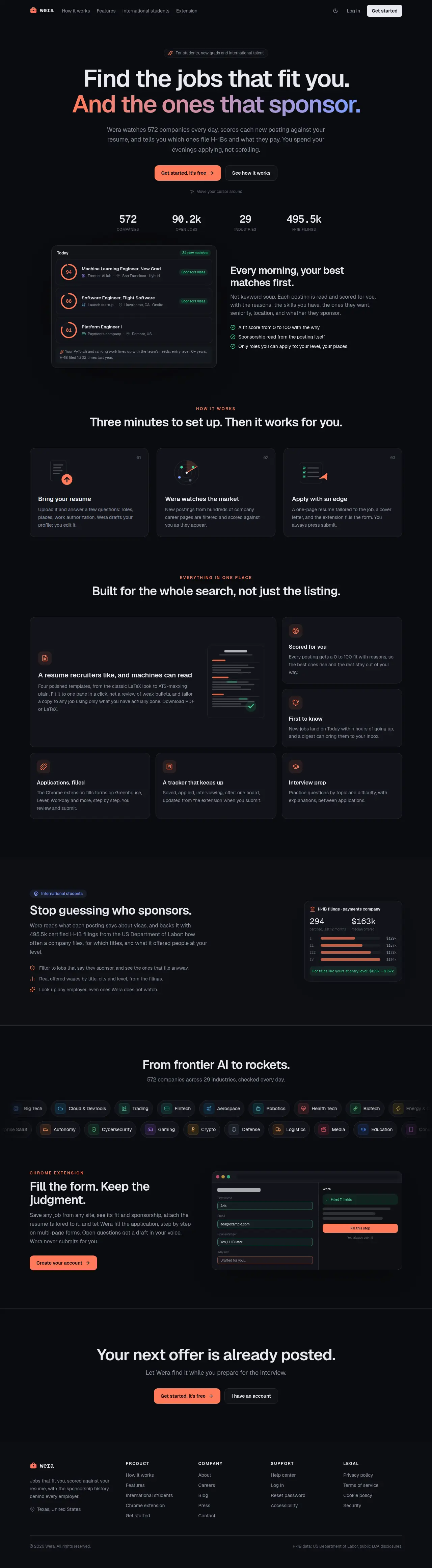
The Wera landing page wera-frontend-five.vercel.apphover to scroll

The interesting problem is cost. Postings are fetched once for everyone, unchanged boards cost nothing, and most jobs are ranked or ruled out locally before a model gets involved, so the LLM reads each posting once rather than once per user.

  1. 01

    Fetch boards

    ETags on every request. An unchanged board answers 304.

    0 bytes if unchanged
  2. 02

    Store changes

    Content hash per posting; only new or changed rows are written.

    shared by all users
  3. 03

    Rule filter

    Role, seniority, location and sponsorship rules, per user.

    40k jobs in 4 s
  4. 04

    Local ranking

    TF-IDF against the profile, so a new user sees ranked jobs in seconds.

    no model
  5. 05

    Shared facts

    One LLM call per posting version: seniority, years, sponsorship.

    1 call, every user
  6. 06

    Fact exclusions

    Too senior, too many years, no sponsorship: dropped before scoring.

    about half drop out
  7. 07

    Fit score

    A compact job card and profile, with a cached prompt prefix.

    ≈ $0.0004 per job
  8. →

    Ranked list

    Today, jobs, industries and an application tracker.

Fig. 1 Wera's matching pipeline. Only the highlighted steps call a model; the rest is shared across users or runs locally.
New user sees ranked jobs
~5 s
was 5 min
Cost of a fit call
$0.00038
was $0.00075
Re-filter 43,732 jobs
4.1 s
was 9.3 s
Ruled out before any fit call
22 of 46
sample run

Measured on development data.

02

Pulse Platform

2026 / Python

A deliberately boring FastAPI service, run like production. The app is not the point; everything around it is.

Kubernetes manifests and a Helm chart, Terraform for the same setup on AWS (VPC, EKS, RDS), CI that tests against real Postgres and Redis and scans images with Trivy, Prometheus and Grafana with two SLO alerts, and Locust load tests next to chaos scripts that kill app pods and the database.

pulse-platform architecture on Kubernetes kubernetes / namespace pulse enqueue consume read / write write scrape alert when an SLO breaks clienthttps ingressnginx pulse-appfastapi / hpa ×2 redisarq job queue pulse-workerhpa ×2 postgresalembic / jsonb prometheus/metrics grafanadashboard alertmanager2 slo alerts terraform: vpc / eks / rds
Fig. 2 Requests reach pulse-app through the ingress; background work is queued in Redis for pulse-worker. Prometheus scrapes the app and Alertmanager fires when either SLO is breached.
SLOs
99.5% availability, p95 under 300 ms
Chaos
kill an app pod, kill Postgres, watch it recover
IaC
Terraform for VPC, EKS and RDS; raw manifests and Helm

Python / FastAPI / Kubernetes / Helm / Terraform / Prometheus / Grafana

03

GraphSentinel

2026 / Go

Research tooling from my thesis: a Go service that flags semantics-preserving obfuscation in source code.

Submit code and get back a machine-readable report: does it look like identifiers were renamed, dead code was inserted, or control flow was reshaped, with a score for each. Jobs run asynchronously on a worker pool, so it can sit inside larger evaluation pipelines.

GraphSentinel request lifecycle POST /analyze 202, then 200 enqueue clientpolls /analysis http apichi / slog worker poolqueued → done identifier renamingsignal + score dead codesignal + score control-flow driftsignal + score reportjson
Fig. 3 A submission is accepted with 202, analysed by three detectors on the worker pool, and polled for its report.

~/research

M.S. thesis, Cyber-Physical Systems Security Lab, UT Arlington, 2026.

Do GNN-based vulnerability detectors survive obfuscation?

Thesis Evaluating the Robustness of GNN Vulnerability Detectors Under Code Obfuscation

Graph neural networks can look very good at spotting vulnerable code on clean benchmarks. Real code is messier, and sometimes deliberately disguised. My thesis evaluates how these detectors behave when code is transformed in ways that keep its behaviour identical: renamed identifiers, dead branches, reshaped control flow.

original.c

int sum(int n) {    int total = 0;    for (int i = 0; i < n; i++)        total += i;    return total;}

obfuscated.c

int f_3a(int v_1) {    int v_9 = 0, v_2 = 0;    if (v_1 < 0 && v_1 > 0)        v_9 = v_1 * 7;    while (1) {        if (v_2 >= v_1) break;        v_9 += v_2;        v_2++;    }    return v_9;}
Fig. 4 All three transformations at once. The function still returns the same value for every input; the question is whether a detector's prediction moves.

GraphSentinel is the service I built to flag these transformations automatically, so experiments can run over whole datasets.

~/experience

Since 2022: fintech, healthcare, e-commerce, and university infrastructure.

Experience

  1. Aug 2025 — present

    Systems Administrator

    University of Texas at Arlington Arlington, TX

    • Managed VirtualBox lab environments on RHEL hosts supporting Windows, Fedora, and Kali Linux VMs and their snapshots for hands-on cybersecurity instruction, enabling reliable and repeatable student security experiments.
    • Owned and maintained Linux-based lab infrastructure and two department RHEL production servers supporting 1,000+ users, diagnosing virtualization and software issues to ensure stable service delivery for students, faculty, and researchers.
    • Designed and deployed an AI experimentation lab using RAG, LangChain, and LangGraph, enabling students and researchers to run LLM experiments on applied AI workflows.
    • Built Python tooling to automate software provisioning and installation workflows across lab machines, eliminating repetitive manual setup and improving consistency across environments.

    RHEL / Linux / VirtualBox / Python / RAG / LangChain / LangGraph

  2. Jan 2025 — Aug 2025

    Graduate Teaching Assistant

    University of Texas at Arlington Arlington, TX

    • Achieved a 15% improvement in average student performance for the Algorithms course by providing tutoring and office hours focused on core concepts.
    • Reduced recurring coding errors and improved code quality by 20% by delivering detailed feedback on C programming assignments and reinforcing best practices.
    • Elevated student satisfaction to 90% by facilitating collaborative debugging sessions and structured code reviews.

    Algorithms / C / Code review

  3. Aug 2023 — Aug 2024

    Full Stack Developer

    Fasi Health Remote

    • Built and maintained full-stack features across patient, driver, and admin workflows using NestJS, TypeScript, React, GraphQL, and PostgreSQL, supporting core business operations in a production healthcare platform.
    • Developed a React Native/Expo mobile app for a ride-hailing service, translating UI designs into functional screens and integrating REST and GraphQL APIs for real-time data flow.
    • Engineered backend infrastructure including NestJS services, GraphQL resolvers, Prisma migrations on a Dockerized PostgreSQL database, AWS Cognito for authentication, S3 for document and media storage, and payment platform integrations.
    • Built CI/CD pipelines with GitHub Actions and AWS Elastic Beanstalk, reducing deployment time by 50% and improving release reliability.
    • Contributed to Agile delivery through sprint planning, code reviews, and merge request approvals, supporting consistent and reliable feature releases.

    NestJS / TypeScript / React / React Native / GraphQL / PostgreSQL / Prisma / Docker / AWS / GitHub Actions

  4. Nov 2022 — Jul 2023

    Front End Web Developer

    Fameve Remote

    • Reduced production issues by 60% by implementing automated testing and improving code quality in an Angular-based e-commerce platform.
    • Developed modular React and Angular components for core e-commerce workflows, consuming REST APIs for data rendering and collaborating with backend engineers to ensure reliable end-to-end feature delivery.

    Angular / React / REST / Automated testing

  5. May 2022 — Nov 2022

    Software Development Intern

    JamboPay Nairobi, Kenya

    • Built REST API endpoints for a fintech payment platform using NestJS, supporting transaction processing workflows in a production environment.
    • Designed and optimized SQL queries to surface transaction data for admin reporting, improving operational visibility into payment workflows.

    NestJS / REST / SQL

Education

  1. 2024 — 2026

    M.S. Computer Science, University of Texas at Arlington

  2. 2018 — 2021

    B.S. Information Technology, Kabarak University, Nakuru, Kenya

~/about

Who's at the keyboard.

About

jesse@chumo

OS
Linux (RHEL, Fedora, Kali)
Host
Dallas, Texas
Kernel
M.S. Computer Science, UTA 2026
Uptime
4 years, 5 months since first job
Packages
python, go, typescript, c/c++, sql
ML
pytorch, tensorflow, gnns, langchain, langgraph, rag
Infra
kubernetes, docker, terraform, aws, github actions
Data
postgresql, redis, mongodb, mysql
Research
gnn robustness under code obfuscation

I started out writing payment APIs at JamboPay in Nairobi, then spent almost two years building healthcare and e-commerce products for remote teams before a master's in computer science at UT Arlington.

At UTA my thesis looked at graph neural networks for vulnerability detection, and I look after the department's Linux lab infrastructure: RHEL servers used by more than a thousand people, VM labs for security classes, and an AI lab built on RAG, LangChain and LangGraph.

The work I enjoy most is where models meet machines: making LLM pipelines cheap enough to run on everything, keeping a cluster healthy while pods die, and writing the scripts that make a room full of Linux machines behave the same.

~/contact

Dallas, Texas. US Central time.

Let's talk.

I'm looking for new opportunities, especially in ML systems, AI infrastructure and platform engineering. Email is the fastest way to reach me.

jessechumo@gmail.com